


To win the T20 World Cup 2026 final against India in Ahmedabad, New Zealand must embrace their “under the radar” status and execute a near-flawless tactical game plan to disrupt the home favorites.
How New Zealand can beat India - Action Plan
To defeat the Indian “juggernaut” in the T20 World Cup 2026 final at the Narendra Modi Stadium, New Zealand must execute the following 11-point tactical blueprint:
1. Maximize the "Brutal Force" of the Opening Partnership
- Finn Allen’s Momentum: Allen is coming off the fastest century in T20 World Cup history (33 balls), an innings Michael Clarke described as seeing “beach balls at a new level”.
- Attacking the Powerplay: India has lost 11 wickets in the powerplay across five innings, often forcing their middle order to rebuild rather than accelerate. If Allen can “pulverize” the new ball, it forces India into a defensive mindset early.
Finn Allen enters the final in historic form following a record-breaking 33-ball century in the semi-final against South Africa. His ability to “pulverize” an attack early on is New Zealand’s best weapon to take the “air out of the stands” in Ahmedabad. Michael Clarke described his current hitting as seeing “beach balls at a new level”. To win, New Zealand must allow Allen and Seifert to attack the powerplay aggressively, as India has shown vulnerability by losing 11 wickets in the first six overs throughout the tournament. This initial explosion is vital to silencing the massive 100,000-plus home crowd.
Also Read: How Finn Allen and Tim Seifert Cruised Past South Africa in T20 World Cup 2026 Semi-Final.
2. Exploit India’s Middle-Overs Stagnation
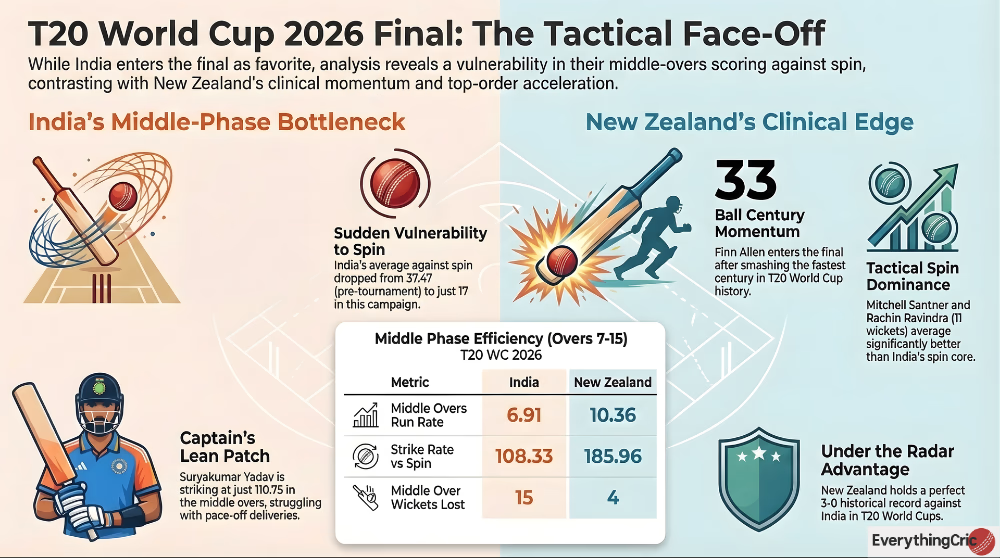
- Lowest Run Rate: Among all Super 8 teams, India has the lowest run rate in the middle overs at 6.91, which drops further to 6.61 when playing at home.
- Vulnerability to Spin: India’s average against spin has plummeted from 37.31 (pre-tournament) to just 17 during this World Cup. Their strike rate against spinners in the middle phase is a modest 108.33, the lowest among the Super 8.
- The Strategy: New Zealand should utilize their “spin depth,” featuring Mitchell Santner, Ish Sodhi, Rachin Ravindra, and Glenn Phillips, to squeeze the Indian middle order. Ravindra is a primary threat to right-handers like Suryakumar Yadav, while Santner and Cole McConchie should be used as “pinch points” against left-handers like Shivam Dube.
New Zealand must capitalize on India’s significant middle-overs stagnation to maintain control. By utilizing disciplined bowling to keep India’s run rate low during these critical overs, the Black Caps can prevent the Indian middle order from building the necessary momentum for a massive total. This phase represents a strategic “pinch point” where New Zealand can effectively choke the game.
3. Leverage Declining Proficiency Against Spin
A critical factor for a Kiwi victory is exploiting India’s declining proficiency against spin bowling. While India previously boasted a strong average of 37.31 against spin, that number has plummeted to just 17 during the 2026 World Cup. The Indian batters have lost 19 wickets to spinners across just five innings while managing a tournament-low strike rate of 108.33 in the middle phase. New Zealand’s “spin density,” led by Mitchell Santner, Ish Sodhi, and Rachin Ravindra, is perfectly equipped to exploit these technical struggles. Forcing India to play spin under pressure will likely result in frequent dismissals.
Also Read: India’s Performance Against Spin at T20 World Cup 2026
4. Target Matchups Against Shivam Dube
Targeting Shivam Dube: R. Ashwin highlighted that NZ spinners should target Dube by bowling wide of the off-stump or using leg-side yorkers to limit his massive reach. New Zealand’s tactical planning should include specific strategies to neutralize the threat of Shivam Dube. R. Ashwin suggests that the Black Caps’ spinners, such as Cole McConchie, should target Dube by bowling wide of the off-stump or using leg-side yorkers. Dube is a lethal hitter of spin, but his massive reach can be limited if the ball is placed outside his primary “wheelhouse”. By forcing Dube to manufacture shots away from his body or skidding the ball onto his back foot, New Zealand can limit his ability to clear the boundaries. This specific matchup is a key “pinch point” in the final.
5. Solve the "Jasprit Bumrah Puzzle" Through Survival
- The “Survival” Approach: Glenn Phillips notes that New Zealand’s strategy involves viewing Bumrah as “human” and being ready to pounce only if he misses his mark.
- Tactical Patience: Rather than taking reckless risks, New Zealand’s middle order may attempt to “take the game as deep as possible,” as England attempted in the semi-final.
- Exploiting Recent Form: Despite his genius, Bumrah conceded 9.46 runs per over against the Kiwis in their last bilateral series, suggesting he can be pressured.
Bumrah is a “match winner” who excels at hitting the blockhole at the death, making him a “run saving machine”. If New Zealand can survive his four overs without losing key wickets, they significantly increase their chances of victory.
6. Focus on Suryakumar Yadav’s Technical Flaws
Suryakumar Yadav’s Lean Patch: The Black Caps must exploit the recent technical struggles of India’s captain, Suryakumar Yadav. Despite his innovative reputation, Yadav has struggled against pace bowling, which has exposed flaws like limited weight transfer and early head movement.
New Zealand’s hit-the-deck pacers, such as Matt Henry and Lockie Ferguson, can capitalize on these recurring mechanical patterns by using hard lengths and subtle movement.
Yadav has only managed a strike rate of 110.75 in the middle overs during this tournament, indicating he is searching for rhythm. Early pressure on the captain could derail the entire Indian batting lineup.
7. Win the Toss and Bowl First to Use Dew
- The Toss is Vital: Experts like R. Ashwin argue NZ’s “best chance” is to bowl first. Significant dew is expected after 8:00 PM, which makes the ball slippery for spinners and allows it to “skid onto the bat,” making chasing significantly easier.
- Pitch Selection: While the surface is expected to be a “red soil” pitch offering true bounce and high scores (par 200), any moisture in the air from the nearby Arabian Sea could make the second-innings defense a “nightmare” for bowlers.
R. Ashwin notes that New Zealand’s “best chance” involves restricting India to a score between 180 and 190 and then chasing. This approach mitigates the risk of defending a wet ball during the second innings.
8. Maintain a "Challenge" State Under Pressure
9. Deploy Rachin Ravindra as a Right-Hander Specialist
Rachin Ravindra will be a vital asset, particularly due to his tournament-leading wicket haul among spinners. He has been exceptionally dominant against right-handed batters, claiming eight wickets at a miserly economy rate of 6.32. New Zealand should utilize him specifically to target India’s key right-handers like Sanju Samson and Suryakumar Yadav. While he has been slightly more expensive against left-handers, his ability to stall momentum in the middle overs is crucial. His presence adds significant “spin depth” to the squad, allowing captain Mitchell Santner to turn every over into a tactical puzzle for the Indian batters.
Also Read: Rachin Ravindra’s Rise and Journey from 2023 World Cup to Now
10. Embrace the "David" Identity Mindset
New Zealand historically thrives when they embrace their “David” identity as perpetual underdogs. Glenn Phillips notes that the Kiwis are often “never given a chance,” yet they consistently reach semi-finals and finals. This mindset allows them to play with a “lack of fear” because the immense weight of expectation rests entirely on India as the home favorites. Mitchell Santner has expressed that he “wouldn’t mind breaking a few hearts” to finally secure a white-ball World Cup title. By focusing inward on execution and energy rather than the partisan crowd, New Zealand can cause a major “boil over”.
11. Adapt Quickly to the Mixed-Soil Pitch
The final will be played on a mixed-soil surface combining red and black soil, which offers true bounce and consistent pace. New Zealand must use their “spin density” and tactical flexibility to adapt to these specific conditions. The pitch is expected to favor high scores with a par total around 200, but “hit-the-deck” pacers like Matt Henry can still find early movement. New Zealand’s ability to pick their extra bowler—whether it be raw pace from Lockie Ferguson or extra spin from Ish Sodhi—based on the final pitch appearance is a genuine advantage. Staying adaptable is the key to mastering Ahmedabad.
Also Read: How the Narendra Modi Stadium Pitch at Ahmedabad Will Play in T20 World Cup 2026 Final
What Do the Cricker Veterans Say About The Match
Willow Talk Cricket Podcast: T20 World Cup Final Preview
Brad Haden and Nathan Lyon highlight the “brutal force” of Finn Allen, whose semi-final century was “ludicrous”. Haden claims the Kiwis “don’t fear India” in home conditions and identifies Mitchell Santner as the “biggest key”. Both Haden and Lyon predict a New Zealand victory.
Beyond23 Cricket Podcast: India Vs. New Zealand T20 Final
Michael Clarke (Pup) calls Jasprit Bumrah the “most important player in the world,” describing him as a “wicket-taking machine”. He praises Finn Allen’s “brutal force,” noting he sees deliveries like “beach balls”. Although Clarke views the final as a 50/50 “coin toss,” he ultimately predicts India will win.
Cricbuzz: Preview - India vs New Zealand
Ajinkya Rahane and Michael Vaughan discuss India’s need to ignore past “scars” and stay “in the moment”. Vaughan notes New Zealand is “due” for a white-ball title and will try to “quiet the crowd”. Ultimately, both analysts predict India as the favorites to win a very close gam
Ash ki Baat: The Final Countdown - IND vs NZ
Ravichandran Ashwin provides deep tactical analysis, identifying Matt Henry and Mitchell Santner as “pinch points” against India. He suggests New Zealand’s “best chance” is bowling first to utilize evening moisture. Despite these threats, Ashwin predicts “India all the way” will secure the championship.



Related News:



Learn more about EverythingCric →
