

If you’ve ever sat in a rain-drenched stadium or stared at your TV screen wondering why a team suddenly needs 12 runs off 2 balls, you’ve likely asked: what is DLS? In the modern era of the T20 World Cup 2026, the Duckworth-Lewis-Stern (DLS) method is the “Hidden Umpire” that translates rain clouds into run targets. It is a mathematical formulation designed to ensure that the team batting second has the same “difficulty” in their chase as the team that batted first, regardless of how many overs are lost. Far from being a random number generator, DLS is the most sophisticated resource-tracking system in global sports.
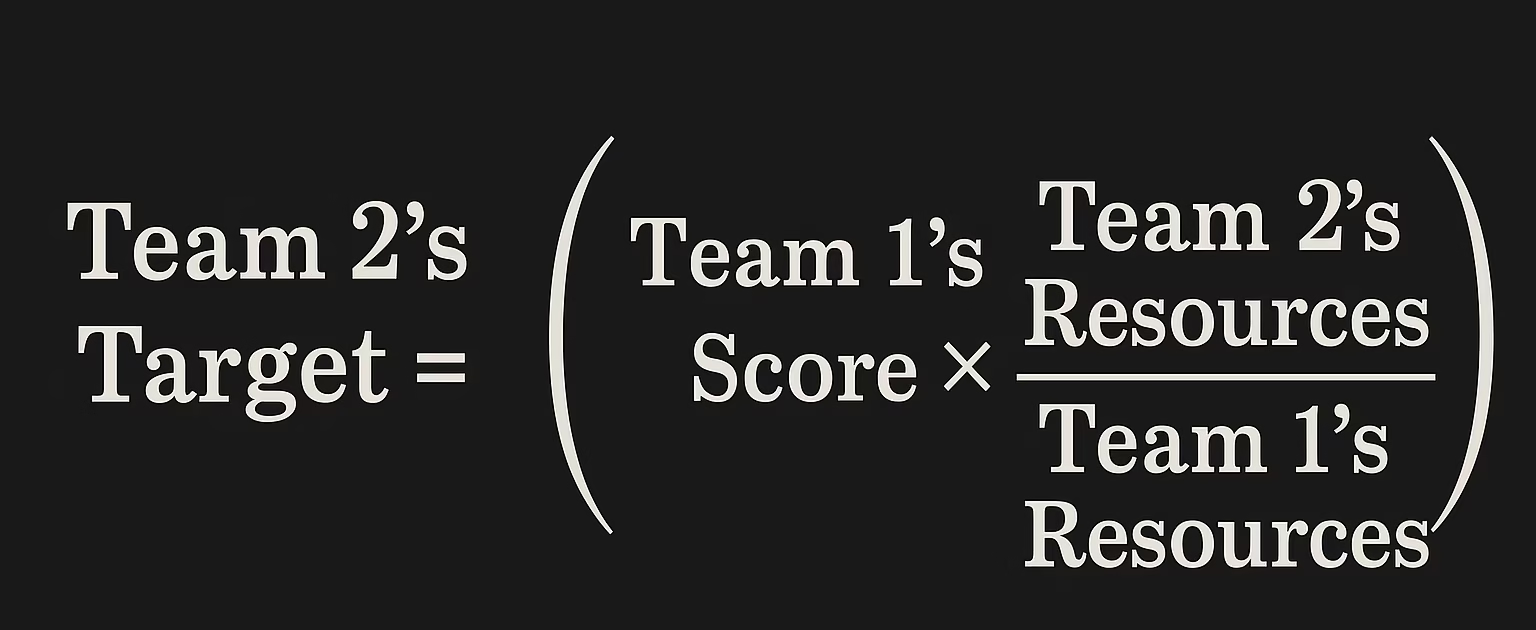
Let us try to understand how this formula was arrived at, and what do each of these factors in the formula mean.
Introduction to the DLS Method
The DLS method was originally developed (and named DL method) by English statisticians Frank Duckworth and Tony Lewis in 1997 and first implemented internationally in 1999. After updates by Australian statistician Steven Stern in 2004, it was renamed to DLS method to reflect modern scoring patterns, especially in T20 cricket, it has become the global standard for handling rain-affected matches in international and franchise cricket

Why Was the DLS Method Needed?
Before the DLS, cricket used methods like Average Run Rate and Most Productive Overs, which often led to unfair results by not considering the match situation properly.
The notorious example is the 1992 World Cup semifinal, where South Africa’s target bizarrely changed to 21 runs off 1 ball after rain. DLS was designed to avoid such outcomes by taking both overs left and wickets in hand into account to determine fair targets
How the DLS Method Works
The DLS method works on the principle that a batting team has two resources available: overs to play and wickets remaining. These resources deplete as the innings progresses.
If overs are lost mid-game, the target for the chasing team is revised based on the percentage of resources still available compared to the total resources used by the team batting first.
Simplified formula used for revised target setting is typically:
Team 2’s Target = Team 1’s Score X ( Team 2’s Resources / Team 1’s Resources)
In the above formula, Resource is derived from ICC published Resource Tables.
Resource percentage tables are tables listing the percentage of “resources remaining” given overs left and wickets lost. For example: 50 overs & 10 wickets = 100% resources.
- Example: In the 2002 ICC published Resource Tables revision it is depicted that if overs remaining is 20 & 8 wickets in hand it means Team-2 has approx. 52.4% resources.
- Another example : If Overs remaining is 30 and Team-2 has 6 wickets in hand then it means Team-2 has 54.1% resources.
In practice, scorers and officials use – Official DLS calculators, Mobile apps, Software integrated into scoring systems. These tools automatically compute revised targets instantly during rain-affected matches, ensuring accuracy and fairness.
So while the concept can be explained simply, the exact calculation is best left to specialised software rather than manual attempt by a lay person.
Resource calculation considers:
- Resources = Overs + Wickets – Every combination of balls left and wickets in hand corresponds to a resource percentage (i.e. for ODI, ideal Resource for Team 2 would be 50 overs + 10 wickets = 100%)
- Interruptions reduce resources: When rain shortens either innings, the method recalculates the target using those percentages.
- Fairness principle: If Team 1 knew from the start it only had fewer overs, it would have batted differently; D/L(S) accounts for that.
- Minimum overs for a result: typically 20 overs in ODIs and 5 overs in T20Is (unless all-out or target reached earlier).
Duckworth Lewis vs DLS method differences
One of the most frequent points of confusion for readers is the Duckworth Lewis vs DLS method differences. While the names are often used interchangeably, they represent two different eras of cricket.
The DL Era (1997–2014): Created by Frank Duckworth and Tony Lewis, the original formula was built for an era where 250 in an ODI was a massive score. It was linear and often struggled to account for the “Death Overs” surge of the modern game.
The DLS Era (2014–Present): After the retirement of the original duo, Australian data scientist Steven Stern updated the algorithm. The “S” in DLS stands for Stern.
The Key Change: Stern’s version accounts for the hyper-aggressive scoring of T20 cricket. It acknowledges that teams today can score 60-70 runs in the final 5 overs—something the original DL formula often undervalued. DLS is essentially the “Patch Update” that made the math catch up to the athleticism.
What happens to the points table if the DLS score is tied?
In a tournament with high stakes, fans frequently search: “What happens to the points table if the DLS score is tied?” If a match is abandoned and the chasing team’s score is exactly equal to the Par Score (to the second decimal point in the professional software), the match is a Tie.
Group Stage: Both teams receive 1 point each.
Net Run Rate: The NRR is calculated as if both teams scored the same number of runs over the same number of overs.
Super Over: Unlike a regular tie, if the match is abandoned at the tie-point, there is no Super Over because the ground is unplayable. However, if the rain stops and the match ends as a tie on the field, a Super Over is played to determine the 2-point winner.
Can a team win on DLS if the minimum overs are not completed?
This is the most critical question for weather-affected matches: “Can a team win on DLS if the minimum overs are not completed?” The answer is a hard No. For a result to be declared using the what is DLS framework, a minimum number of overs must be bowled in the second innings:
T20 Internationals: At least 5 overs must be completed.
ODI Internationals: At least 20 overs must be completed.
If the rain comes down at 4.5 overs in a T20, even if the chasing team has scored 100 runs without losing a wicket, the match is a “No Result.” The points are shared, and the NRR is not affected. This is why you often see captains “sprinting” to finish the 5th over when clouds are hovering.
Will machine learning replace the DLS method in 2026?
As we look toward the future, many tech-savvy fans ask: “Will machine learning replace the DLS method in 2026?” The current DLS method is a “Closed Box” formula, meaning it doesn’t look at “Live Factors” like:
Pitch conditions (Is it a dust bowl or a green top?)
Boundary sizes.
Individual player form (e.g., Is Suryakumar Yadav still at the crease?).
Data scientists are already testing AI-driven “Live Par” models that use real-time probability. However, the ICC prefers DLS because it is transparent and predictable. A machine learning model might decide a target is 180 because “The pitch is turning,” which would lead to massive protests from teams. For now, the “Human-Calculated” DLS remains the gold standard for fairness.
FAQ: Everything You Need to Know About DLS
Q: Can a team win on DLS if the minimum overs are not completed?
A: No. In T20Is, a minimum of 5 overs must be bowled in the second innings for a result. If rain stops play before the 30th ball is bowled, the match is a “No Result,” even if one team is clearly ahead.
Q: Why does the target sometimes go UP when overs are reduced?
A: This happens if the team batting first had their innings interrupted. DLS assumes the team batting second has an advantage because they know exactly how many overs they have left from the start, allowing them to play more aggressively with all 10 wickets. To compensate, the target is increased.
Q: Is DLS used in Test Cricket?
A: No. Since Test cricket has no limit on overs and is based on “Time” rather than “Resources,” DLS does not apply. If a Test match is rained out, it is simply a Draw.
Five famous matches to show D/L(S) in action
1. Zimbabwe vs England, 2nd ODI, Harare — Jan 1, 1997
Why it matters: First international decided using D/L; Zimbabwe won by 7 runs.
2. South Africa vs Sri Lanka, ICC World Cup 2003
What happened: SA misread the par score under D/L and settled for a tie, getting knocked out.
3. India vs England, 4th ODI, Bengaluru — Nov 23, 2008
Textbook D/L first-innings reduction: Match cut to 22 overs a side; India 166/4, England’s target revised to 198 and they fell 19 short.
4. England vs West Indies, T20 World Cup 2012 (Pallekele)
5. India vs Bangladesh, T20 World Cup 2022, Adelaide — Nov 2, 2022
Modern DLS at work: Rain break mid-chase; Litton Das’s blitz had BAN ahead, but the revised target tightened the endgame and India won.
Watch: ICC & YouTube clips – icc
Recent reminder: DLS still decides big games — e.g., Australia’s rain-hit win over Bangladesh at the 2024 T20 World Cup used DLS in Antigua.



Check out related news:





Learn more about EverythingCric →

I think what you said made a lot of sense. But, what about
this? suppose you composed a catchier post title? I am not suggesting your
information is not good, but suppose you added something to maybe grab folk’s attention? I mean What Is DLS Or The Duckworth-Lewis-Stern Method?
is kinda vanilla. You should look at Yahoo’s front page
and watch how they create news headlines to get people to open the links.
You might add a related video or a pic or two to
grab readers excited about everything’ve written. Just my opinion, it would make your website
a little livelier.
Nice take! You are right, this is definitely worth considering! Definitely on my next posts!