


Women vs Men Cricket: What's Different—and Why It Makes Sense
The debate around women vs men cricket has grown louder in recent years, not because the game needs comparison, but because the sport itself is evolving. Fans now follow women’s cricket with the same excitement, the same emotion, and the same expectations once reserved only for the men’s game. From rising viewership and global superstars to record-breaking performances, women’s cricket has moved far beyond the shadow of comparison — it stands as its own powerful force. Yet, the discussion continues: how do the two formats differ, where do they overlap, and what does the future really look like for both sides of the sport?
1. Equipment and the Ball
Ball size and weight
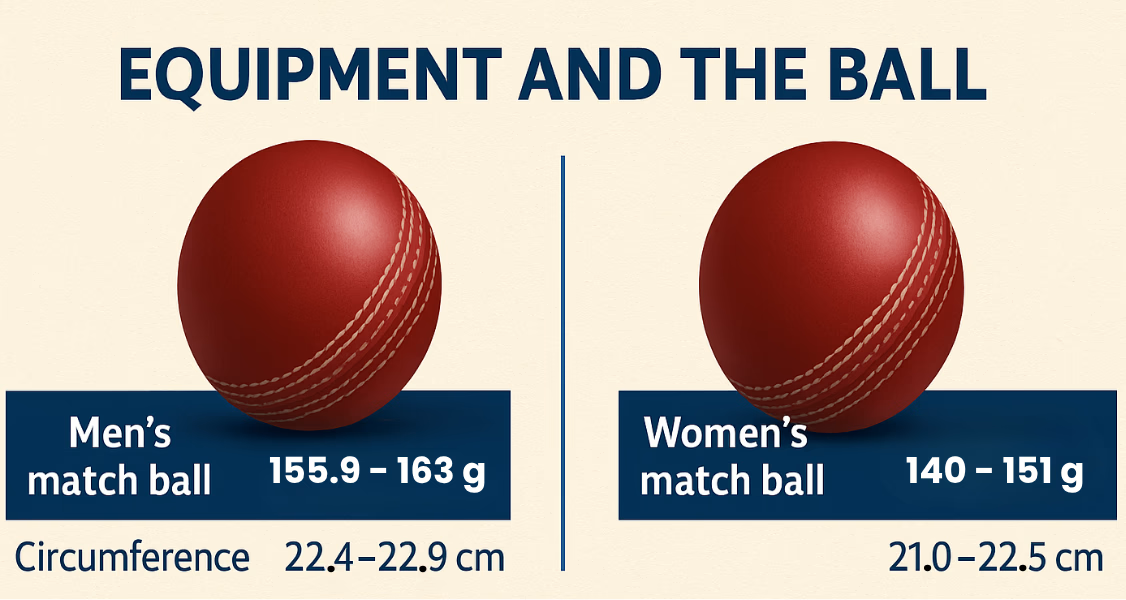
Men’s match ball is slightly bigger and heavier. It weighs in the range of 155.9–163 g. Circumference of ball is in the range 22.4–22.9 cm.
Women’s match ball weighs in the range of 140–151 g. Circumference lies in the range 21.0–22.5 cm.
Why is this difference present?
A lighter, slightly smaller ball is a pragmatic choice. It keeps release speeds, impact forces, and swing/control relationships in a sweet spot for elite women bowlers and batters, much as youth cricket uses lighter balls for age-appropriate play. It’s a calibrated way to preserve balance between bat and ball across different physical baselines. (The MCC codifies the men’s ball; the women’s ranges are set in ICC playing conditions.)
Read more on this point on the Lord’s cricket website.
2. Boundaries and Playing Area
Boundary ranges
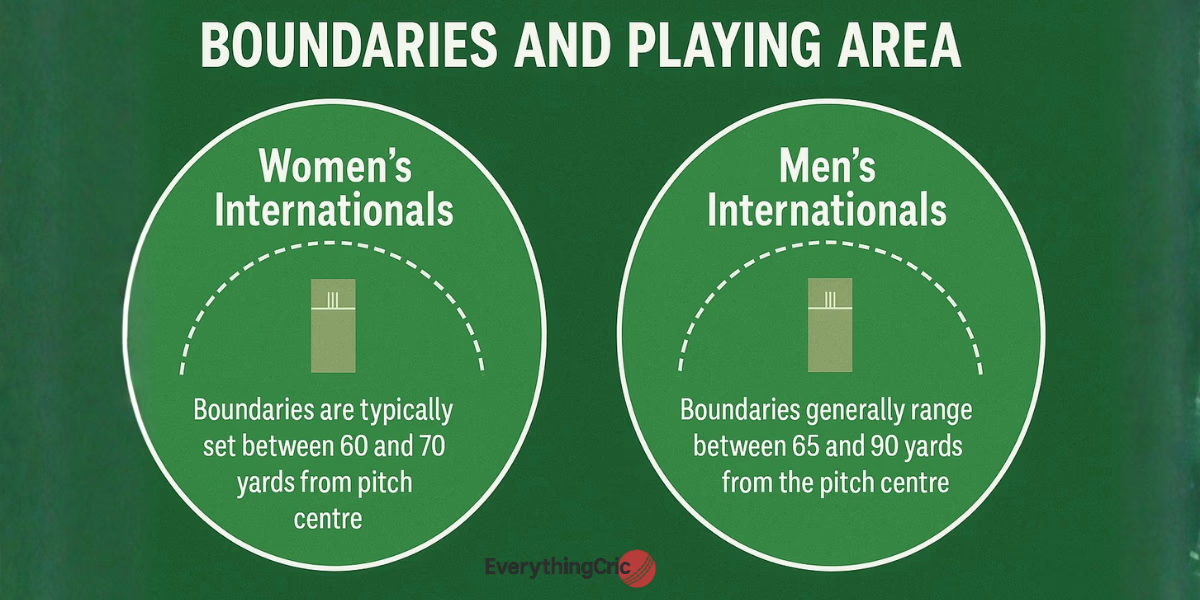
- Women’s internationals: Boundaries are typically set between 60 and 70 yards from the pitch centre. However, legacy exemptions permit shorter boundaries—down to 55 yards—on older or space-constrained grounds, as outlined in BCCI and ICC documentation.
- Men’s internationals: Boundaries generally range between 65 and 90 yards, depending on ground dimensions and event regulations, following standard ICC playing conditions.
Why smaller boundaries in the women’s game?
It normalizes outcome probabilities (fours/sixes vs. dismissals) for the power and bat speeds typically observed in women’s cricket. In other words: comparable skill → comparable entertainment → fairer contest. It’s the same logic other sports use (e.g., net height or implement mass) to preserve the essence of play.
The ICC also mandates a 3-yard safety gap between the rope and hard objects/boards. This rule exists across both games and affects how far ropes can be pushed out.
3. Formats and Playing Hours
Women’s Tests vs Men’s Tests
- Women’s Tests are usually four days with an expected 100 overs/day (≈17 overs/hour).
- Men’s Tests are five days with 90 overs/day (≈15 overs/hour)
Why four days?
Historically, women’s Tests developed with shorter durations, partly due to scheduling windows, audience expectations, and legacy domestic structures. The higher over-rate target in women’s Tests (100/day) compensates for the lost day to create opportunities for results. It’s a policy knob the ICC uses to balance time and outcome likelihood.
Follow-on thresholds
Because many women’s Tests are four-day matches, the follow-on benchmark is 150 runs (like a four-day men’s fixture), rather than the 200 used for five-day Tests.
4. ODI Playing Conditions and Fielding Restrictions
Inner Circle
For men’s cricket, the inner circle radius is 30 yards, while for women’s cricket, it is 25.15 yards.
Powerplay Rules
Men’s ODIs have three powerplay phases with varying field restrictions, while women’s ODIs have one mandatory powerplay (overs 1–10) allowing only two fielders outside the circle.
Fielding Restrictions (Post Powerplay)
After the powerplay, men’s cricket allows up to five fielders outside the circle, while women’s ODIs permit only four fielders outside.
Boundary Distance
Boundaries in men’s internationals range between 65 and 90 yards, whereas in women’s matches, they are 60 to 70 yards, with legacy grounds sometimes reduced to 55 yards.
Over Rate & Duration
Men’s matches target around 15 overs per hour, while women’s games aim for 15.79 overs per hour (two sessions of 3 hours 10 minutes each)
Gameplay Intent
Men’s playing conditions create multi-phase tactical battles emphasizing power hitting, while women’s conditions focus on balanced scoring opportunities, maintaining competitiveness and match tempo.
5. T20 Playing Conditions and Fielding Restrictions
Inner Circle
For men’s cricket, the inner circle radius is 30 yards, while for women’s cricket, it is 25.15 yards.
Fielding Restrictions (Post Powerplay)
After the powerplay, men’s cricket allows up to five fielders outside the circle, while women’s ODIs permit only four fielders outside.
Boundary Distance
In men’s T20Is, boundary lengths usually range between 65 and 80 yards, while in women’s T20Is, boundaries are set between 60 and 70 yards, with legacy venues allowed to go as short as 55 yards.
Innings Break Duration
Men’s T20Is have a 20-minute innings break, whereas women’s T20Is have a shorter 15-minute break to maintain a faster pace of play.
Over Rate & Duration
Men’s T20Is typically maintain 14–15 overs per hour, while women’s T20Is are structured to ensure a brisker tempo, keeping matches within broadcast-friendly time limits.
6. Match Economics: Pay, Prize Money, and Leagues
Prize money parity at ICC events
In July 2023, the ICC announced equal prize money for equivalent men’s and women’s ICC events—a policy milestone that reset expectation across the ecosystem.
National boards and match fees
In October 2022, the BCCI introduced equal match fees for India’s women and men in internationals (₹15 lakh Test, ₹6 lakh ODI, ₹3 lakh T20I). It doesn’t equalize annual income by itself (match volume and contracts still differ), but it was a landmark step.
Women's Premier League (WPL) effect
- The WPL has injected top-tier professional opportunities and significant salaries (team salary caps around INR 15 crore) and created a deeper market for domestic and international players.
- Viewership is surging—estimates show TV reach more than doubled from WPL 2023 to 2024, with momentum continuing in 2025—evidence that investment + quality product = audience.
Why does the money matter to how the game plays?
Because professionalization expands support staffs, analytics, S&C, recovery tech, and talent depth. That lifts skill ceilings (pace, bat speed, throwing velocity), narrows the gap to men’s benchmarks, and, over time, may justify revisiting certain playing-condition knobs (e.g., boundary bands) without rushing it prematurely.
Summarising the differences
Women vs Men Cricket — Compact Facts Only
All key numbers in the fewest possible rows. No explanations.
1) Equipment & Ball
| Spec | Men | Women |
|---|---|---|
| Weight | 155.9–163 g | 140–151 g |
| Circumference | 22.4–22.9 cm | 21.0–22.5 cm |
Reference: MCC (ball); ICC women’s playing conditions.
2) Boundaries & Playing Area
| Aspect | Women | Men |
|---|---|---|
| Boundary distance | 60–70 yds (legacy ≤55) | 65–90 yds |
| Safety buffer | ≥3 yds from rope to fixed objects/boards | |
Reference: ICC/BCCI event & playing conditions.
3) Formats & Playing Hours (Tests)
| Aspect | Women | Men |
|---|---|---|
| Match length | 4 days | 5 days |
| Overs / day | 100 (≈17/hr) | 90 (≈15/hr) |
| Follow-on | 150 runs | 200 runs |
Reference: ICC Test playing conditions.
4) ODI Playing Conditions
| Item | Women | Men |
|---|---|---|
| Inner circle radius | 25.15 yds | 30 yds |
| Powerplay | One (overs 1–10); max 2 outside | Three phases; varying limits |
| Post-PP fielders outside | Up to 4 | Up to 5 |
| Boundary distance | 60–70 yds (legacy ≤55) | 65–90 yds |
| Over rate / duration | ≈15.79 ov/hr (2 × 3h10m) | ≈15 ov/hr |
Reference: ICC ODI playing conditions.
5) T20I Playing Conditions
| Item | Women | Men |
|---|---|---|
| Inner circle radius | 25.15 yds | 30 yds |
| Post-PP fielders outside | Up to 4 | Up to 5 |
| Boundary distance | 60–70 yds (legacy ≤55) | 65–80 yds (typical) |
| Innings break | 15 min | 20 min |
| Over rate / tempo | Structured brisk tempo | ≈14–15 ov/hr |
Reference: ICC T20I playing conditions.
6) Economics (Prize Money, Fees, Leagues)
| Item | Women | Men |
|---|---|---|
| ICC prize money (since Jul 2023) | Equal prize money (equivalent events) | |
| BCCI India match fees (since Oct 2022) | Equal: ₹15L Test, ₹6L ODI, ₹3L T20I | |
| League (India) | WPL cap ~INR 15 cr; strong viewership growth (2023→2025) | IPL (separate structure and caps) |
Reference: ICC announcements; BCCI releases; WPL media notes.
Conclusion - What Matters
Cricket’s beauty is that it scales. The women’s game is not a copy of the men’s; it’s the same sport, tuned so that a cover-drive still thrills, a yorker still shocks, and a boundary save still earns a roar. Laws stay universal; playing conditions fine-tune fairness, safety, and theatre for the cohort. As investment fuels strength, speed, and depth, administrators can keep adjusting the dials—data-first—to maintain that bat-vs-ball equilibrium fans love.
And the fans are showing up. With equal ICC prize money, equal India match fees, booming WPL audiences, and record stadium moments already in the books, the women’s game has its own engine now. The differences you see aren’t second-best—they’re deliberate design choices to make the cricket better.



Tags:
Check out other blogs:






Check out latest news:







Learn more about EverythingCric →

I seriously love your website.. Great colors & theme.
Did you make this website yourself? Please reply back as I’m
trying to create my very own blog and would like to learn where you got
this from or just what the theme is named.
Thank you!
Hi. Yes, I made this website myself. I used NewsPro theme by Elementor. Wish you all the best! You can reach out to me, if you would like to know anything else! Happy to help!