
Table of Contents
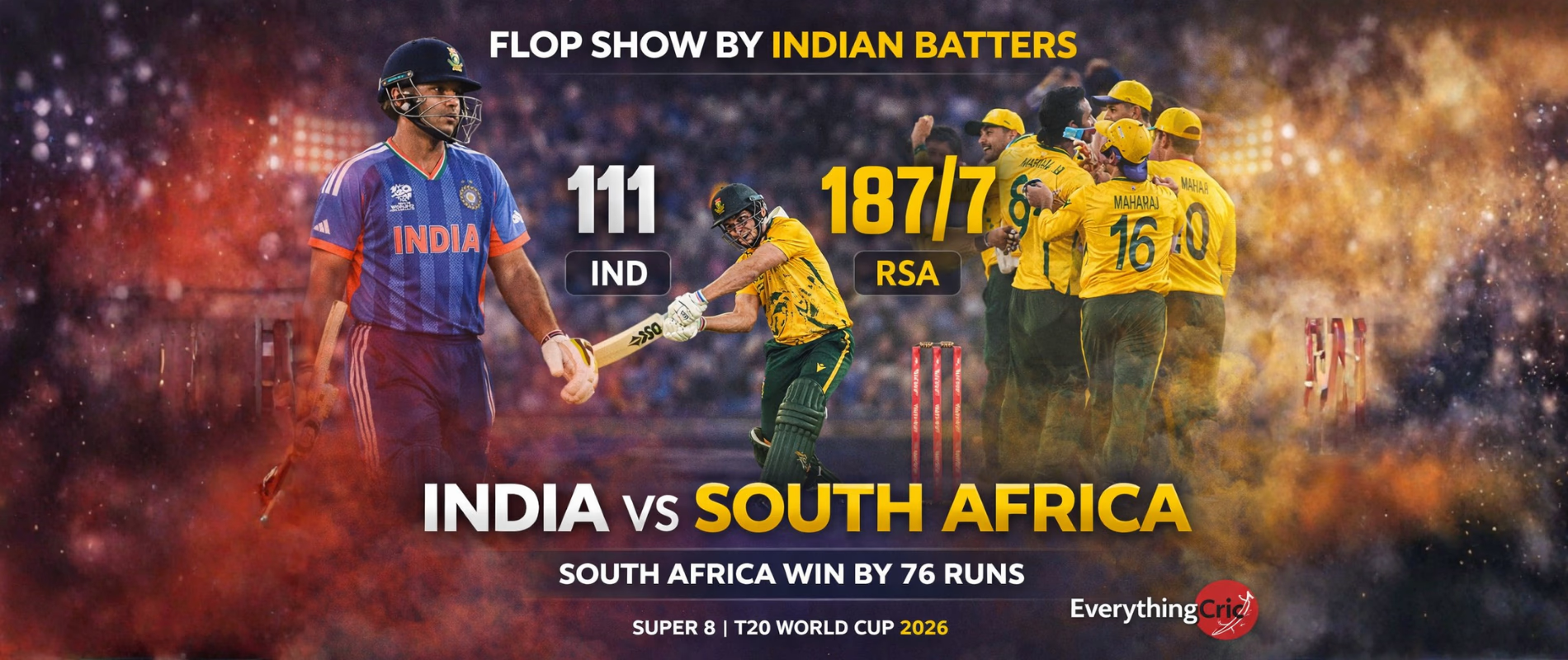
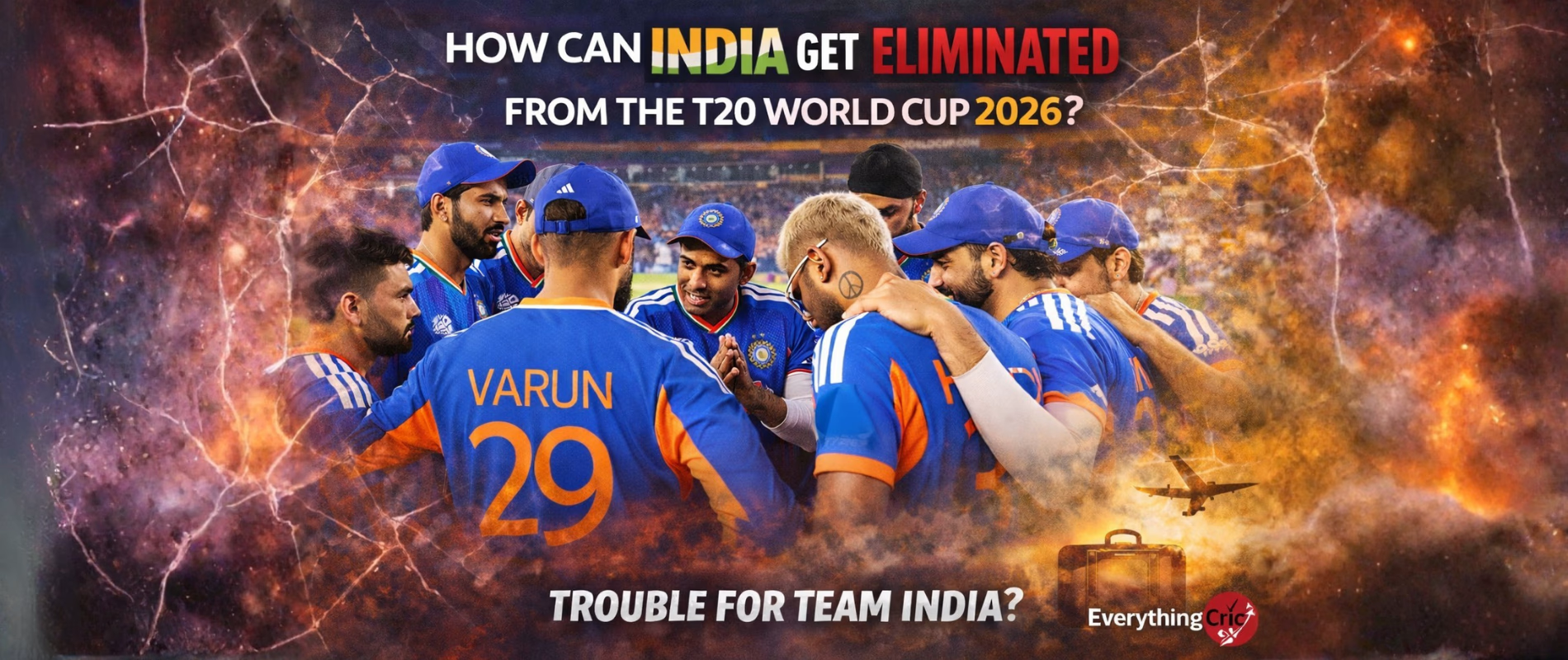
ToggleThe defending champions are staring at the exit door. After a humiliating 76-run defeat to South Africa at the Narendra Modi Stadium, the How Can India Get Eliminated from T20 World Cup 2026 search query is trending for all the wrong reasons. With a damaged Net Run Rate (NRR) of -3.800, Suryakumar Yadav’s men have no room for error. While they still have two games left in Chennai and Kolkata, the mathematical path to the semi-finals is now a tightrope walk that could end in heartbreak if results elsewhere go against them.
India walked into the T20 World Cup 2026 as favourites. They leave the Super Eight — if the cricket gods have their way — as one of the tournament’s great cautionary tales. The signs are already there. The cracks are already visible. And the teams capable of exploiting them are already in the same group.
This is not clickbait. This is cricket. Here is exactly how India get eliminated from the T20 World Cup 2026.
The Nightmare Scenario for Indian Fans: How One More Loss Ends the Dream
The simplest answer to how can India get eliminated from T20 World Cup 2026 is a single defeat in their remaining matches. India faces Zimbabwe on February 26 and West Indies on March 1. If India loses to a resurgent Zimbabwe in Chennai, they stay on 0 points while others move ahead, effectively knocking the hosts out before they even reach Kolkata. Even if they win one but lose the other, finishing on 2 points will not be enough to displace South Africa or the winner of the Zimbabwe-West Indies clash.
The NRR Trap: Can 4 Points Still Lead to Elimination?
Super 8 - Group 1 Points Table




Even if India wins both remaining games to reach 4 points, they aren’t safe. Because of the -3.800 NRR, India is at the mercy of other results. If Zimbabwe beats West Indies and then West Indies pulls off an upset against South Africa, three teams could finish on 4 points. In this “Group of Death” scenario, India’s massive deficit from the Ahmedabad collapse would likely see them finish 3rd or 4th on NRR, resulting in a shock exit for the co-hosts
Key Points To Consider For Indian Fans:
The Group is Not as Safe as It Looks
India topped Group A with ease — three wins from three, including a 61-run demolition of Pakistan that had the entire subcontinent convinced the trophy was already packed and labelled. But the Super Eight is a different animal entirely. Group 1 features West Indies, South Africa, and the tournament’s most dangerous dark horse — Zimbabwe. India need to finish in the top two to advance. One bad night, one dew-soaked surface, one Muzarabani spell that nobody saw coming — and suddenly the calculation changes completely.
The margin for error in the Super Eight is brutally thin. India have no room for complacency, and complacency, historically, is exactly what India bring to matches they are supposed to win comfortably.
The Chepauk Trap
India play Zimbabwe at the MA Chidambaram Stadium in Chennai on February 26. Every Indian cricket fan will tell you that Chepauk is India’s fortress. What they won’t tell you is that it is also a graveyard for teams that bat second on a deteriorating surface — including India themselves.
By the time India and Zimbabwe face off, the Chepauk pitch will already have hosted one Super Eight match. It will be dry, worn, and turning sharply. Varun Chakravarthy will be dangerous — but so will Sikandar Raza. And here is the uncomfortable truth that Indian fans need to sit with: Raza has spent the last two months at Boland Park in the SA20, thriving on exactly this kind of surface. He is not walking into unfamiliar territory. He is walking into his living room.
If India bat first and post 160 or fewer on a slow Chepauk track, Zimbabwe — with Bennett unbeaten in this tournament and Raza at number five — are perfectly capable of chasing it down. It has happened before. It will happen again.
The Bumrah Problem Nobody Is Talking About
Jasprit Bumrah is India’s match-winner. He is also India’s greatest vulnerability hiding in plain sight. When Bumrah bowls well, India win. When Bumrah has an off night — or when a team targets him intelligently — India’s bowling attack looks remarkably ordinary.
Arshdeep Singh has been inconsistent at the death. Kuldeep Yadav, brilliant as he is, can be neutralised on flat surfaces. Chakravarthy’s mystery works once; batters who have faced him in franchise cricket — and every Super Eight side has players who have — know his variations intimately. If Bumrah is taken out of the equation by an injury scare, a difficult pitch, or simply a batsman who reads him — India are suddenly very beatable.
West Indies, in particular, have the firepower to go after Bumrah early. Rovman Powell hitting sixes over long-on off a 145kph yorker is not a hypothetical. It happened in the 2024 World Cup. It can happen again.
The Ahmedabad Collapse
The turning point that put India in this mess was the Powerplay against South Africa. Chasing 188, India lost Ishan Kishan for a duck and Tilak Varma for 1. The inability to handle Marco Jansen’s bounce (4/22) meant India was never in the chase. As captain Suryakumar Yadav noted, “You can’t win the game in the powerplay, but you can lose it,” and India did exactly that, ending their 12-match T20 World Cup winning streak in the most painful way possible.
The Pressure of Playing at Home
A billion expectations. Every match broadcast to 500 million screens. The weight of a nation that does not accept defeat gracefully. Playing at home in an ICC tournament is not an advantage for India — it is a psychological burden that has broken them before.
The 2023 ODI World Cup final at Narendra Modi Stadium. The 2016 T20 World Cup semi-final at the Wankhede. History is littered with moments when India’s home advantage became home pressure, and home pressure became home heartbreak. The Super Eight is being played across Mumbai, Chennai, and Delhi — three of the most intense cricket atmospheres on earth. One bad session, one dropped catch, one moment where the crowd’s silence becomes deafening — and the floodgates can open.
How can India still qualify for T20 World Cup 2026 semi-final after 76-run drubbing?
For India to qualify, they must win both matches against Zimbabwe and West Indies. Ideally, they need South Africa to remain undefeated and win all their games. This would keep the other two teams (WI and ZIM) on low points, allowing India to sneak through in 2nd place with 4 points regardless of their poor NRR.
The Bottom Line
India are still favourites to win the T20 World Cup 2026. Let nobody tell you otherwise. But favourites get eliminated. It happens at every tournament, in every sport, in every era of cricket.
Zimbabwe can beat them in Chennai. West Indies can overpower them at Wankhede. South Africa can outthink them in Delhi. Any one of these outcomes is not just possible — it is entirely plausible given the form, the conditions, and the pressure that comes with being the team everyone is gunning for.
India’s path to the semi-final is clear. So is the trapdoor beneath their feet.
One slip. That is all it takes.



Related news: