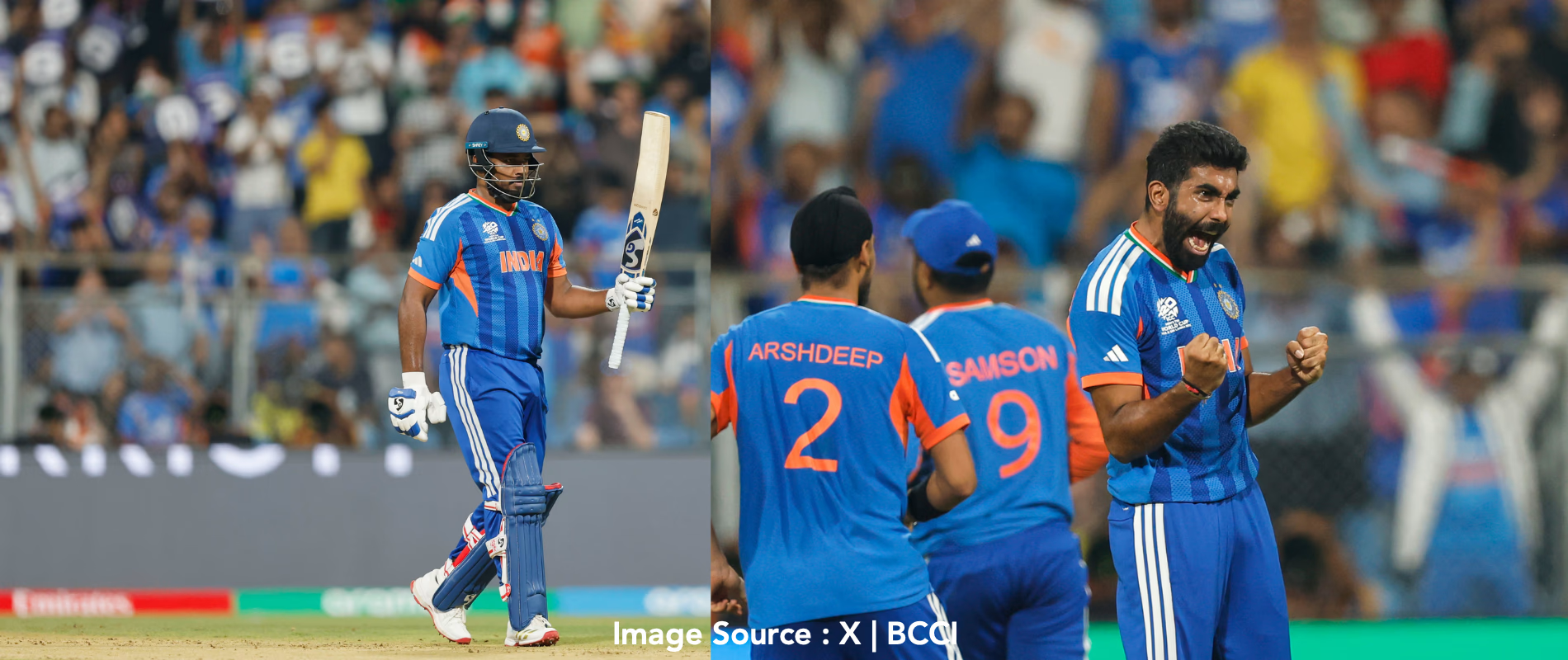
How India can beat New Zealand in Sunday’s T20 World Cup 2026 Final is the question every cricket fan is asking right now. With the Narendra Modi Stadium set to host 130,000 fans under lights in Ahmedabad, this promises to be one of the greatest nights in T20 cricket history — and India will need a near-perfect performance to deliver it.
New Zealand are not here to make up the numbers. The Black Caps dismantled an unbeaten South Africa side by nine wickets at Eden Gardens, with Finn Allen smashing the fastest century in T20 World Cup history — 100 off just 33 balls. They are dangerous, cohesive, and peaking at precisely the right time.
So how can India beat New Zealand and retain the T20 World Cup title? Here is the complete tactical blueprint.
Master Plan for India to Beat New Zealand in Final
1. Strategic Management of Toss and Dew
With the match being played in the evening, dew is expected to be a major factor after 8:00 PM, making the ball difficult for bowlers to grip.
There is a 90% probability that the team winning the toss will choose to bowl first to take advantage of easier chasing conditions in the second innings.
If India is forced to bowl second, they must rely on their experience in heavy-dew franchise and international games to stay competitive.
2. Stop Finn Allen Early — This Is How India Beat New Zealand's Biggest Weapon
The Kiwi opener is the most destructive batter at this World Cup and the single biggest threat to India’s title defence.
Allen and Tim Seifert are the most feared opening partnership in the tournament. Against South Africa, they put on 117 together inside 10 overs. Against the UAE in the group stage, they posted an unbeaten 175 — the second-highest opening stand in T20 World Cup history. Their blueprint is simple: attack from ball one, turn the powerplay into a war zone, and psychologically drain the chasing team before the innings is even half over.
The key to how India can beat New Zealand starts with Jasprit Bumrah in over one. Not over two. Over one. Bumrah’s ability to generate awkward bounce, hit the yorker consistently, and vary pace without telegraphing it makes him the best individual weapon India have against both openers. A wicket inside the powerplay — especially Allen’s — reshapes the entire match.
Hardik Pandya must complement Bumrah from the other end, targeting Seifert’s tendency to go hard at full deliveries. One wicket in the powerplay and New Zealand’s entire game plan falls apart.
3. Exploit New Zealand's Middle-Order Vulnerability
After Allen and Seifert, the middle order — Glenn Phillips, Rachin Ravindra, Daryl Mitchell, James Neesham — is capable but hasn’t been tested under real pressure in this tournament. In the semi-final against South Africa, once Seifert fell for 58, Ravindra played a supporting role while Allen finished the chase almost single-handedly. The truth is, New Zealand haven’t needed their middle order to fire once in this World Cup.
India’s spinners — Axar Patel, Varun Chakravarthy — must be primed to exploit that vacuum the moment either opener departs. A tight over from Axar in the 7th or 8th — he was exceptional against England — can transform 60/0 into 80/2 in the space of two balls. Wickets in that overs 7–12 window are how India can beat New Zealand’s chase engine before it gets going.

4. Post 180+ — India Can Beat New Zealand With Runs on the Board
One of the clearest answers to how India can beat New Zealand is this: don’t give Allen a target he can reach in 14 overs. If India post 175 or under, a batter in Allen’s current form only needs one over to “get in” before the game is effectively over. Post 185-plus, and even his extraordinary aggression starts to feel borderline. The pressure of the chase itself becomes a weapon.
Sanju Samson, Abhishek Sharma and Ishan Kishan must replicate the powerplay intent that built 253 against England. A score of 67–70 in the first six overs puts New Zealand on the back foot from the outset. Suryakumar Yadav and Tilak Kumar’s composure in the middle overs unmatched 360-degree finishing in the death give India the template to construct something formidable.
India must bat all 20 overs and keep wickets in hand for the final five. The semi-final showed what’s possible when the death batting fires — Sunday calls for more of the same.
5. The Chakravarthy–Ravindra Battle: India's Spin Trap
How India can beat New Zealand in the middle overs comes down to one word: Chakravarthy.
Rachin Ravindra is New Zealand’s most technically complete batter and the X-factor in their lineup. Unlike Allen and Seifert, Ravindra doesn’t just smash — he reads situations, adjusts to conditions, and builds innings. If the openers fall cheaply, Ravindra is the one player capable of anchoring a New Zealand recovery.
Varun Chakravarthy, India’s most potent spinner in this tournament, is the answer. His mystery variations and ability to deceive left-handers have already rattled some of the best batters in the world at this World Cup. Chakravarthy vs Ravindra is the tactical duel within the final — and winning it could be the defining moment of how India beat New Zealand.
Axar Patel’s left-arm angle to right-handers serves as an important secondary option. But Chakravarthy should be deployed the instant Ravindra walks to the crease.
6. Use Ahmedabad's Conditions — That's How India Beat New Zealand Tactically
Ahmedabad is known for its large outfield and extra pace and bounce compared to the Wankhede. The Ahmedabad pitch is expected to be a mixed-soil surface with a greater proportion of red clay, offering more consistent bounce and pace than the slow black-soil track of the 2023 ODI World Cup final.
This surface favors India’s aggressive stroke-makers and allows them to play their shots with trust. Fast bowlers can generate extra movement and carry early in the innings due to the firm nature of the red soil. South Africa’s batters notably struggled against deliveries that held up off a slower Eden Gardens surface in the first semi-final. Ahmedabad’s pace-friendly conditions are a different challenge — and India’s seamers must embrace it.
Bumrah and Pandya should use the extra bounce aggressively in the first ten overs. A bouncer barrage at Seifert — who loves the leg side — could prove highly effective. India’s batters, conversely, should look to hit straight and hard through the V rather than go across the line. The large outfield punishes mistimed cross-bat shots. The team that reads and adapts to Ahmedabad will hold a distinct edge over the one that tries to reproduce what worked at the Wankhede.
Also Read: The Ghost of Ahmedabad Pitch and How It Failed India
7. Countering New Zealand’s Off-Spin Tactics
Mitchell Santner frequently uses off-spinners like Cole McConchie and Rachin Ravindra in the powerplay to exploit India’s left-handed batters. Indian batters like Abhishek Sharma and Ishan Kishan must have a clear plan to neutralize this “slow-poison” approach.
Despite losing 15 wickets to off-spin during the tournament, India’s management remains confident in their batters’ ability to handle these matchups in the final.
8. Maintaining Elite Fielding Standards
India must replicate the “spectacular fielding” seen in the semi-final, particularly the brilliance of Axar Patel.
Avoiding lapses is crucial, as New Zealand is technically the better fielding side on paper.
One dropped catch can change the course of the game, similar to how Harry Brook’s drop of Samson at 15 allowed him to score a match-winning 89.
9. Supporting Varun Chakravarthy’s Role
While there are concerns about Varun Chakravarthy’s form and batters “lining him up,” captain Suryakumar Yadav has publicly backed him as the “world number one bowler“.
India needs Varun to regain his confidence as a wicket-taker in the middle overs to relieve pressure on Bumrah.
Matchups will be key; the management must decide whether to use him or a sixth-bowling option depending on New Zealand’s batting lineup.
6. The Final Piece of How India Can Beat New Zealand: The Psychological Edge
Sometimes the most powerful weapon in a final is history — and India have it in their favour.
New Zealand have appeared in six ICC finals in eleven years and won none. They lost the 2021 T20 World Cup final to Australia. They lost the 2019 ODI World Cup final in the cruelest manner imaginable against England. The Black Caps are phenomenally composed and adaptable, but there is a reason the phrase “New Zealand in ICC finals” carries the weight it does. The pressure of a final’s last ten overs has historically found a way through even their steely exterior.
India, by contrast, are the defending T20 World Cup champions. Jasprit Bumrah, Suryakumar Yadav — these are players who have been on this stage before and know how to win it. The psychological edge belongs to India. But only if they respect New Zealand enough not to take it for granted.
India must use the energy of 130,000 home fans at the Narendra Modi Stadium to test the patience and nerves of the New Zealand bowlers. While Santner has expressed a desire to “silence the crowd” and “break a billion hearts,” India’s relaxed and “in the present” camp mood could neutralize the pressure of expectations.
Overcoming the 0-3 historical T20 World Cup record against New Zealand requires a “conservative shell” to be shed in favor of India’s current peaking form.



Related News: