Table of Contents
ToggleJhulan Goswami: The Chakdaha Express Who Redrew India’s Fast-Bowling Map
If you grew up in India in the 2000s, you probably heard the name Jhulan Goswami said with a mix of pride and disbelief. How could someone that tall, that relentless, keep steaming in for two decades—and do it with such calm?
From debut in January 2002 to Padma Shri in 2012 and then a farewell at Lord’s in September 2022, Goswami’s career is the long arc of Indian women’s cricket itself: from fringe coverage to packed stadiums and prime-time finals. She finished with 255 ODI wickets (most in women’s ODIs), 44 Test wickets and 56 T20 wickets, and a reputation for being the game’s gold standard in discipline and craft. We will try to throw some light on her inspirational journey from a small town to a guard-of-honour at Lord’s, England.
Jhulan's Humble Background
Born in a small town of Chakdaha, West Bengal (1982), before Jhulan Goswami became the face of Indian fast bowling, she was just a tall, shy girl.
It was the late 1990s — women’s cricket in India barely had infrastructure, sponsorship, or even recognition. There was no WPL, no televised matches, not even regular domestic coverage. For a young girl who loved pace bowling, there wasn’t a clear path. Only instinct, and a lot of courage.
Jhulan's first inspiration to take up cricket
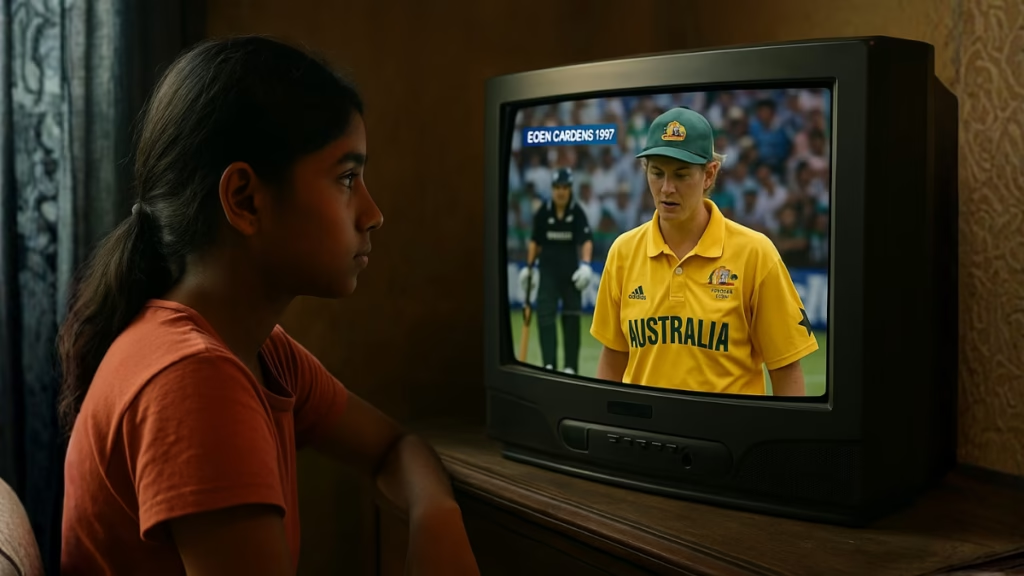
Jhulan was just a teenager when she first saw women’s cricket on television — the 1997 Women’s World Cup final between Australia and New Zealand, played at Eden Gardens. She wasn’t in the stadium that day, but she later said that watching Belinda Clark lead Australia and seeing fast bowlers in action made her realize that..
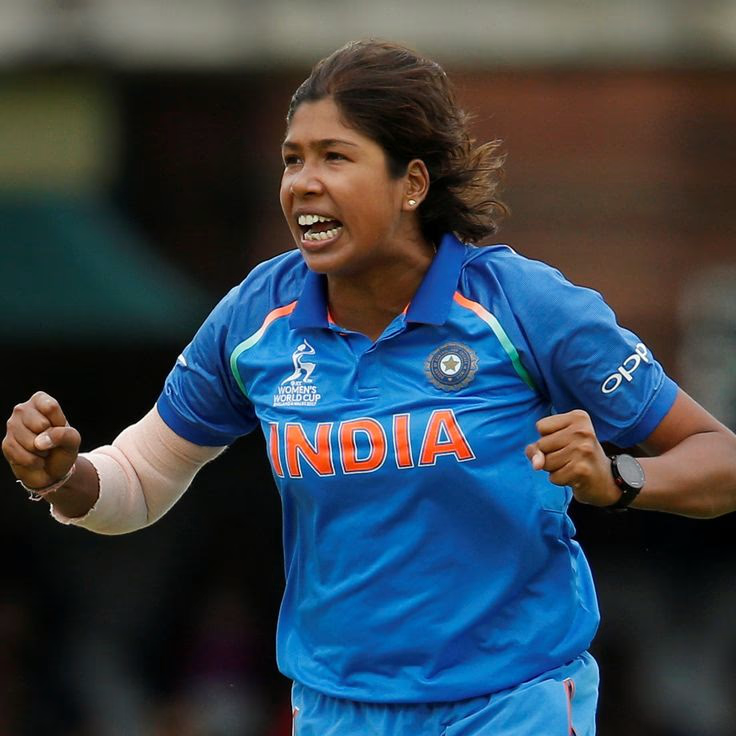
Yes, women can play cricket at this level too. That was the day I decided I wanted to be one of them....
— Jhulan Goswami
At the time, Chakdaha had no proper cricket academies for girls. There weren’t even local tournaments where she could bowl with a hard leather ball. But Jhulan was hooked.
She started playing with boys in her neighborhood, often being the only girl on the ground — and almost always having to prove she could belong there.
Jhulan's Road to Debut
Jhulan Goswami was first spotted by former Bengal coach and talent scout Swapan Sadhu and former Bengal women’s cricketer Swarna Mukherjee, who saw her raw pace and stamina at a training camp at Vivekananda Park, Kolkata. They were immediately impressed by her natural high-arm action and encouraged her to join the Bengal women’s team trials.
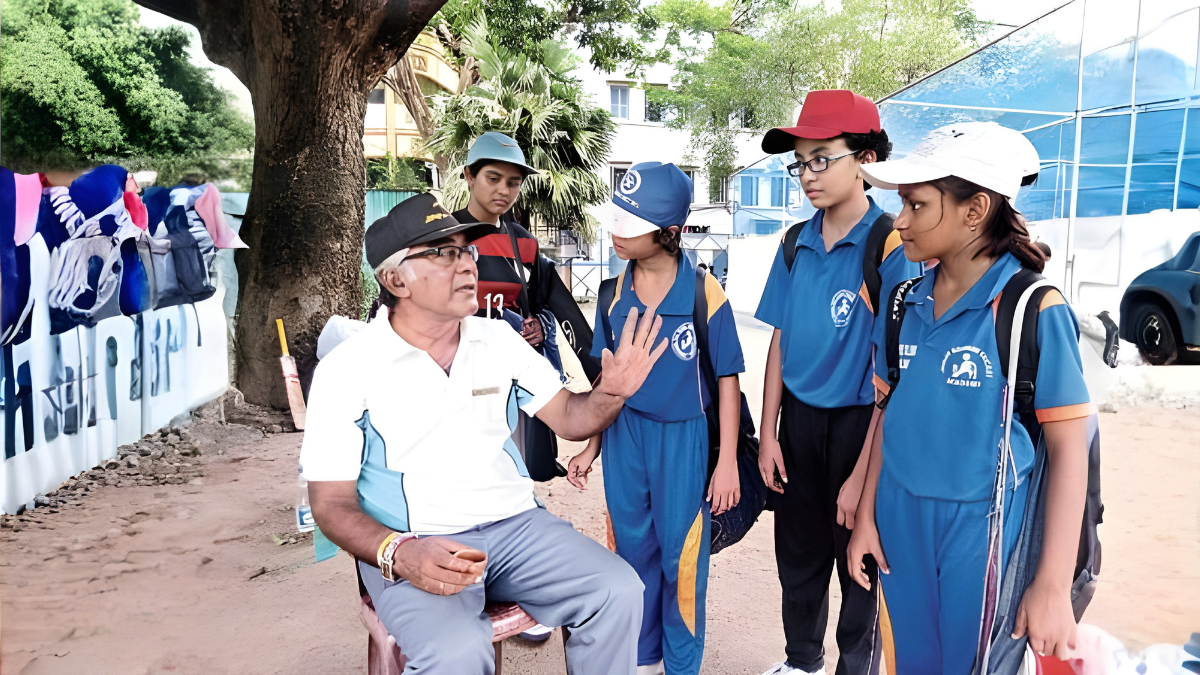
Jhulan has often credited Swarna Mukherjee for nurturing her skills in those early days. Mukherjee helped refine her run-up, her balance at the crease, and her fitness routines when there were hardly any facilities for women fast bowlers in the region.
Swarna di was the one who believed in me when no one even knew I could bowl fast. She would stand by the nets and tell me, ‘Just keep bowling. Your time will come.’....
— Jhulan Goswami
After joining the Bengal senior women’s camp under Swarna Mukherjee’s guidance, Jhulan’s pace stood out in domestic matches.
That’s when Latika Kumari, a then-national selector, took note of her performances during the Inter-State Women’s Championship. Jhulan’s consistent breakthroughs earned her a spot in the East Zone team, and from there, she was fast-tracked into the India squad in 2002 for the England series.
Jhulan Goswami - Career Stats
ODIs: 204 matches, 255 wickets
Jhulan Goswami made her ODI debut in January 2002 against England, a time when women’s cricket barely found space in the sports pages. Fast forward two decades, and she left the game in 2022 as the highest wicket-taker in Women’s ODI history — 255 wickets in 204 ODIs at an average of 22.04 and an economy rate of just 3.37 runs per over.
She became the first woman ever to cross the 200-wicket mark in ODIs in 2018 — a milestone that symbolized more than personal success; it marked India’s arrival as a side with sustained fast-bowling excellence.
Her spells against Australia (Adelaide, 2008) and South Africa (Vadodara, 2018) remain masterclasses in control — cutting through top orders with unerring accuracy. She wasn’t just a bowler; she was India’s tactical foundation.
Tests: 12 matches, 44 wickets
Women’s Test cricket may be a rarity, but every time Jhulan Goswami got the red ball in hand, she made it count. Her 12 Tests between 2002 and 2021 brought 44 wickets at an average of 17.36, including three five-wicket hauls and one 10-wicket match — a feat few women have achieved.
The highlight of her Test career came in Taunton, 2006, when she demolished England in their own conditions with figures of 5 for 33 and 5 for 45, giving India a historic Test victory on English soil. It remains one of India’s greatest Test wins — and the defining moment of Goswami’s red-ball career. Check out the full scorecard for this 10-wicket haul match against England.
Even with limited opportunities, she maintained world-class numbers: average under 18, strike rate around 52, and a wicket every few overs. Her consistency was such that captains never needed to overthink — new ball in her hand meant India had a chance to break through early.
T20 Internationals: 68 matches, 56 wickets
When Twenty20 cricket entered the women’s game in the mid-2000s, it was a new, chaotic, and almost alien format. Batters were swinging harder, captains were experimenting, and the pace of the game seemed tailor-made for spinners. But Jhulan Goswami — then already an established ODI workhorse — didn’t step back. She adapted.
Jhulan was part of India’s first-ever women’s T20 International, played against England at Derby in August 2006 — a time when even the ICC was unsure of how the format would evolve. For India, it was more about testing combinations than chasing entertainment.
Between 2006 and 2018, Goswami played 68 T20 Internationals, taking 56 wickets at an economy of 5.45 and an average of 21.94. Those numbers might not jump out until you realize this: she played most of her T20 career in an era when the average team score hovered between 120 and 130, and seamers had to operate with only two fielders outside the circle during the first six overs.
Her best figures in T20Is — 5 for 11 against Australia in 2012 at Visakhapatnam — still stand as one of the finest spells ever by an Indian seamer in women’s T20s. That night, she dismantled the world champions with precision swing bowling, proving that pace and accuracy could still dominate in the shortest format.
Jhulan Goswami - Her World Cup Woes and her "Only Regret"
I have played two World Cup finals but couldn’t win the trophy. That remains my only regret because you prepare for a World Cup for four years. There is a lot of hard work.’....
— Jhulan Goswami
Jhulan Goswami’s name and World Cups are inseparable. Across five tournaments — 2005, 2009, 2013, 2017, and 2022 — she played a role that few bowlers could sustain for that long. Her 43 wickets remain the most by any bowler in Women’s ODI World Cup history.
For all her records and milestones, Jhulan Goswami has often said that the one thing missing from her glittering career is a World Cup winner’s medal. In her farewell interviews, she admitted it remains her “only regret” — having played two finals, in 2005 and 2017, and coming heartbreakingly close both times. “We reached the final twice, but somehow couldn’t cross the line. That still hurts,” she told reporters before her last international match at Lord’s in 2022. Yet, she spoke without bitterness — only pride and perspective. “I gave everything I had for my team. Sometimes, destiny doesn’t give you the trophy, but it gives you the journey. And that journey was beautiful.”
Her World Cup record isn’t just about wickets — it’s about moments. In 2005, she was just 22, yet she helped lead India to its first-ever World Cup final, beating New Zealand in the semi-final with crucial wickets up front. Even though India lost to Australia in the final, her accuracy and aggression won admiration worldwide.
In 2022, she made her final World Cup appearance in New Zealand — still clocking around 120 km/h and still bowling those probing outswingers. Few athletes stay relevant over two decades. Jhulan Goswami made it look routine.
Jhulan Goswami - Her Smooth Transition to the Next Generation
When Goswami retired from T20Is, she didn’t exit the scene — she stepped into mentoring seamlessly. Her work with the Mumbai Indians Women’s team in the WPL (2023) shows how her tactical brain continues to evolve with the format. MI’s quicks — Issy Wong, Nat Sciver-Brunt, and Pooja Vastrakar — all credited her for reading conditions better and staying sharp under pressure during their title-winning run.
Even in her coaching phase, she approaches T20 cricket with a bowler’s curiosity. For Goswami, it’s never been about speed alone; it’s about angles, fields, and intent — lessons she’s now passing on to players who grew up watching her bowl.
In one of her most memorable interviews, Jhulan once said:
When I started, there was no roadmap. There was just love for the game. I had to create my own road — brick by brick....
— Jhulan Goswami
That road — from a sleepy station in Chakdaha to the packed stands of Lord’s — is now part of cricket history.
And that’s what makes her legacy more than just wickets. It’s about endurance, equality, and the courage to start running before a track even existed.



Check out related blogs: