Table of Contents
ToggleSohail's Stare to Swing King: Venkatesh Prasad Uncovered
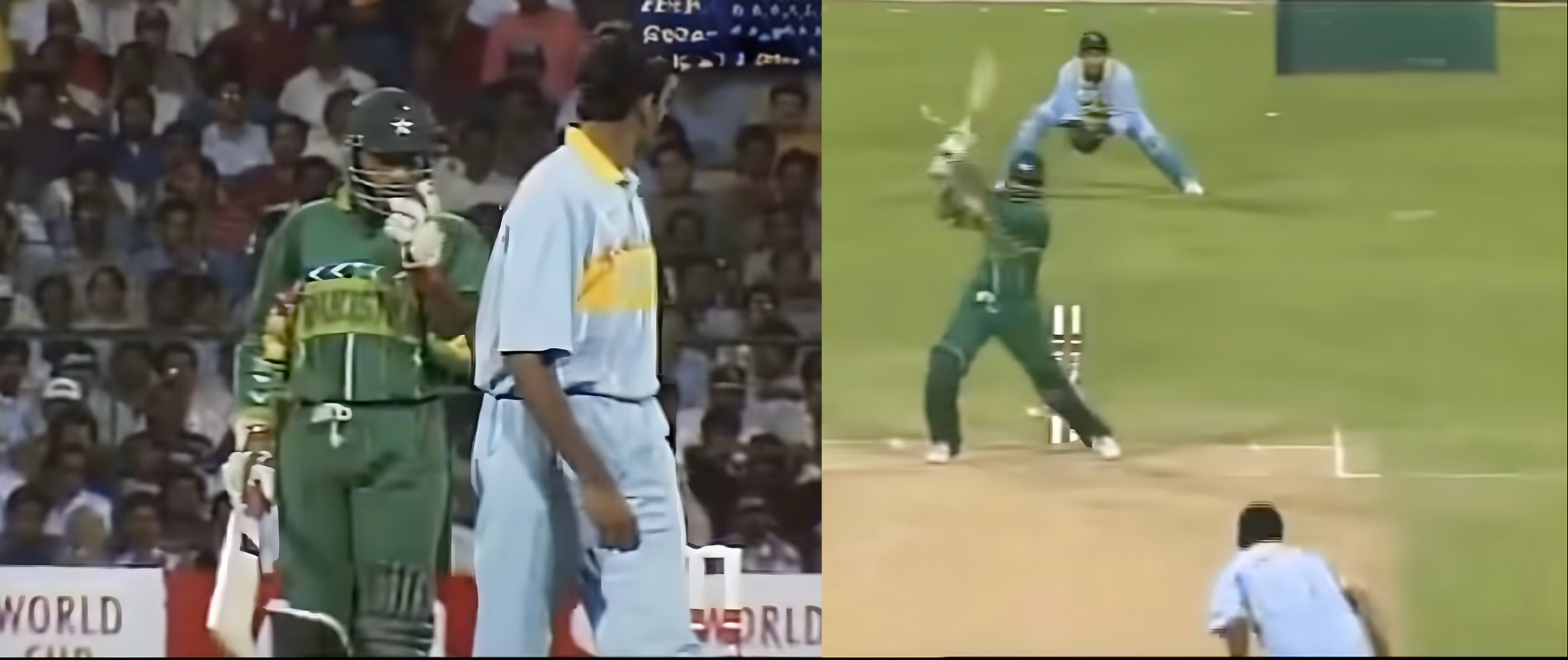
In the electrifying 1996 World Cup quarterfinal at Bengaluru’s M Chinnaswamy Stadium, Pakistan’s Aamir Sohail smashed Venkatesh Prasad for a boundary through extra-cover, then taunted him by pointing his bat toward the ropes, signaling he’d repeat the shot next ball. Prasad, fueled by the high-stakes India-Pakistan clash and a roaring 35,000-strong crowd, responded with ice-cold precision on the very next delivery, uprooting Sohail’s off-stump and delivering a fiery send-off that silenced the opener and sparked Pakistan’s collapse from 113/1 to 239 all out. This iconic sledging showdown, often called cricket’s ultimate revenge moment, propelled India to a 39-run victory and cemented Prasad’s legacy as the “Sledging Slayer.”
Early Life & Background of Venkatesh Prasad
Venkatesh Prasad, born Bapu Krishnarao Venkatesh Prasad on August 5, 1969, in Bengaluru, Karnataka, is a former Indian cricketer renowned for his right-arm medium-fast bowling, particularly in partnership with Javagal Srinath. He played 33 Tests, claiming 96 wickets at an average of 35.00, and 161 ODIs with 196 wickets at 32.30. A Bachelor of Engineering from M.S. Ramaiah Institute of Technology and holder of a postgraduate certificate from the University of London, he transitioned into coaching and commentary post-retirement.
Growing up in Bangalore during the 1970s–80s, he was exposed to a variety of sports — not just cricket but also games like hockey, volleyball, and football, reflecting the vibrant sporting culture of the city. Though formal cricket facilities were limited, young Prasad played tennis-ball and informal neighbourhood matches with friends. Over time, he gravitated toward pace bowling, inspired partly by Indian fast-bowlers of that era and by his own athletic build.
He eventually joined the state side — playing first-class cricket for Karnataka cricket team — where his consistent performances earned him a call-up to the national side.
Rise to National Team & International Debut
Prasad made his One Day International (ODI) debut for Indian national cricket team on 2 April 1994, against New Zealand at Christchurch. After a couple of seasons making his mark in ODIs, he earned his Test debut on 7 June 1996, playing against England at Edgbaston.
Around this time, he formed a lethal new-ball bowling pair with Javagal Srinath. Their contrasting styles — Srinath’s pace and Prasad’s seam + swing + clever cutters — brought a fresh dimension to India’s pace attack in the mid- to late-1990s.
Style, Strengths & Bowling Craft
What made Venkatesh Prasad stand out wasn’t express speed — but control, variety, and cunning use of seam, swing, and cutters (especially slow leg cutters). He was one of the early Indian bowlers to master the slower-ball variations and deceptive cutters, which proved very effective in ODIs as well as Tests.
His lanky frame helped generate awkward angles, especially on pitches that offered movement. On helpful tracks, abroad or in favorable Indian conditions, he could trouble even top batsmen. His strengths lay in accuracy, subtle movement, and bowling intelligent spells rather than sheer pace explosions.
Career Highlights & Stats
Over his international career (1994–2001), Prasad played 33 Tests and 161 ODIs for India. In Tests, he claimed 96 wickets, with a best bowling figure of 6 for 33 — achieved against Pakistan in 1999 during a home Test series. That spell even included a remarkable stretch where he took 5 wickets for no runs.
One of his most memorable performances came in 1996 in Durban, South Africa, when he recorded a rare ten-wicket haul in a Test match — a stellar feat for an Indian seamer during that era. In ODIs, he picked up 196 wickets, with a personal best of 5 for 27.
One of the most iconic moments of his career — etched in many fans’ memories — was during the 1996 Cricket World Cup quarter-final against Pakistan. After being hit for a boundary and sledged by Aamir Sohail, Prasad responded with calm and precision: on the very next delivery, he clean-bowled Sohail. That moment not only restored composure but also shifted momentum in favour of India.
These performances showcased that Prasad was far more than a support bowler — under the right conditions, he could be a match-winner. His clever bowling, especially seam and cutters, made him a key part of India’s pace attack through the 1990s.
Arjuna Award: In recognition of his contributions, he was awarded the prestigious Arjuna Award in the year 2000. Maps Also earlier, in 1996–97, he had been named CEAT International Cricketer of the Year — a testament to his impactful performances during that period.
Late Career, Challenges & Retirement
Like many fast- or medium-pace bowlers, Prasad’s later years were marked by injuries and a dip in form. After the 2001 Test series against Sri Lanka, he played his final Test on 29 August 2001.
He tried to make a comeback for a few years, but consistent national selection eluded him. Eventually he retired from all forms of cricket in May 2005, after a long first-class career with Karnataka that spanned from 1991 to 2005.
Even after retirement, the legacy of his spells — especially the sharp seamers and cutters — remained remembered among fans and critics alike.
Life After Playing: Coach, Commentator & Beyond
Prasad didn’t disappear after retirement. He shifted focus to coaching and mentoring young bowlers. He served as bowling coach for the Indian national team from 2007 to 2009. He also worked as a bowling coach/consultant for various Indian Premier League (IPL) franchises. Over the years, his experience — especially with seam, swing and cutters — helped guide younger bowlers adjusting to pace and conditions.
Beyond cricket, reports suggest he took up roles outside sport as well — offering a balanced post-cricket life.
Legacy & What Made Venkatesh Prasad Special
What stands out in Prasad’s career is that he wasn’t the fastest bowler — but perhaps one of the smartest. In an era when express pace bowlers were rarer in India, he brought control, seam, swing, cutting variations and intelligent bowling to the table. His ability to adapt — especially with slower leg cutters — made him effective in ODIs and helped India compete overseas.
He proved that pace isn’t everything — that subtle movement, discipline, and clever variations can outfox even the most aggressive batsmen. For many young bowlers, Prasad’s career remains an example of how technique and brain can complement or even substitute raw pace.
Moreover, as a mentor and coach after his playing days, he contributed to grooming a generation of bowlers who could learn from his strengths and approach.
Ending Thoughts : A Journey of Discipline, Intelligence & Quiet Impact
Venkatesh Prasad’s story is not one of flash or flamboyance. It doesn’t have hundreds of wickets or dominance like some legends. Instead, it’s a story of grit, intelligence, craft, and consistency. It’s about a lanky boy from Bangalore who embraced his strengths, understood his craft, and left his mark on Indian cricket in the 1990s and early 2000s.
His legacy lies less in overwhelming statistics and more in subtle, memorable spells — in being the bowler who, when the pitch helped, could rise to the occasion; in being part of a generation that helped India build a credible pace attack.



Tags:
Check out our other blogs:





Check out latest news: